 EN
EN

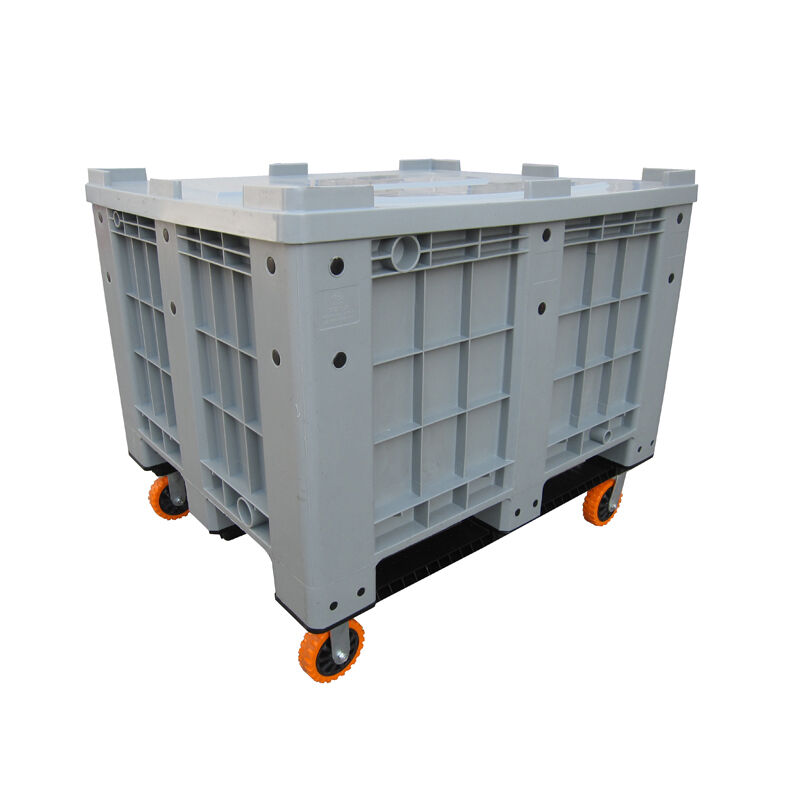
Maximizing Space and Stackability with Pallet Boxes
Vertical Stacking Efficiency in Warehouses and ISO Containers
Pallet boxes revolutionize vertical storage through standardized dimensions and reinforced structural designs that enable safe, high-density stacking. In warehouse operations, they support stacking heights of up to 8 units—40% higher than irregular containers—optimizing cube utilization in alignment with ISO container loading benchmarks. Their interlocking design prevents shifting during transit, while rigid sidewalls evenly distribute weight loads. This stacking efficiency reduces storage footprint requirements by approximately 25%, allowing logistics managers to store more goods within existing facilities. For shipping containers, pallet boxes achieve near-100% vertical space utilization by eliminating air gaps between irregularly shaped cartons—enabling a 30% reduction in required container shipments for equivalent volumes, according to a 2023 logistics study.
Pallet Box vs. Traditional Cartons: Density and Utilization Data (ISO Container Study, 2023)
A 2023 ISO Container Study analyzed 500 transoceanic shipments and found pallet box configurations increased cargo density by 41% while reducing handling labor by 34%. The data reveals three critical efficiency differentials:
| Metric | Pallet Boxes | Traditional Cartons | Improvement |
|---|---|---|---|
| Items per 40ft container | 1,850 | 1,100 | +68% |
| Volume utilization | 94% | 63% | +31% |
| Loading time (minutes) | 78 | 132 | -41% |
Higher consolidation density directly lowers freight costs by $370 per container and reduces carbon emissions through fewer shipments. These gains stem from pallet boxes’ elimination of void spaces and seamless compatibility with automated handling systems—advantages unattainable with inconsistently sized cartons. As a result, 78% of surveyed manufacturers are transitioning bulk shipments to pallet box systems.
Enhanced Load Stability and Cargo Protection
Structural Engineering of Pallet Boxes: Load-Bearing Design and Shock Absorption
The structural integrity of pallet boxes comes from engineered load-bearing designs—including corner reinforcements and double-walled construction—that distribute weight evenly across the base and prevent deformation under heavy loads. Integrated shock-absorbing features—such as corrugated cardboard layers or polyethylene foam liners—dampen impacts during transit. Unlike traditional cartons, pallet boxes maintain rigidity when stacked, eliminating the risk of column collapse responsible for 37% of supply chain product damage (Logistics Quarterly, 2023). This transforms static containers into dynamic protective systems, with materials selected specifically for compression resistance and vibration mitigation.
Real-World Impact: 42% Reduction in Product Damage After Adopting Reinforced Pallet Boxes
A 2023 ISO container study demonstrated that reinforced pallet boxes reduced product damage rates by 42% compared to shrink-wrapped pallets. This improvement stems from their unified structure, which prevents load shifting and minimizes edge crush scenarios—common failure points during sudden stops that cause $740k in average annual losses per warehouse (Ponemon Institute, 2023). Pallet boxes eliminate this vulnerability through full-wall support systems that absorb lateral forces, interlocking stackability that prevents toppling, and uniform tension distribution across all surfaces. The resulting damage reduction translates to 23% lower insurance premiums and 31% decreased waste disposal costs—validating their long-term economic advantage.
Boosting Operational Efficiency with Pallet Box Handling
Forklift and Pallet Jack Compatibility Through Standardized Dimensions
Standardized pallet box dimensions enable seamless integration with material handling equipment like forklifts and pallet jacks. Workers simply slide forks beneath the integrated pallet base for instant, stable transport—eliminating manual lifting and reducing loading/unloading time by up to 40% compared to irregular containers. Warehouses benefit from predictable workflows, as all units fit uniformly into racking systems and conveyors without custom adjustments. At shipping docks, ISO-compliant dimensions streamline container loading, while standardization cuts operator training time: new staff can handle pallet boxes safely within hours. This plug-and-play compatibility accelerates throughput and reduces labor costs across high-volume operations.
Long-Term Cost Efficiency of Pallet Box Logistics
Total Cost of Ownership: Freight, Fuel, Labor, and Damage Mitigation Savings
Adopting pallet boxes slashes total logistics expenses by optimizing multiple cost layers. Superior stackability reduces freight volume—up to 30% fewer shipments versus loose cartons—directly lowering fuel consumption and carbon emissions per unit shipped. Standardized dimensions accelerate loading/unloading, cutting labor hours by 15–25% at distribution hubs. Most critically, integrated structural reinforcement minimizes product damage, avoiding replacement costs averaging $50k–$740k annually per facility (Ponemon Institute, 2023). When damage mitigation, reduced shipping frequency, and labor efficiencies compound, businesses achieve ROI in 10–24 months.
FAQ
What makes pallet boxes ideal for vertical stacking?
Pallet boxes feature standardized dimensions and reinforced structural designs, allowing them to support up to 8 stacking units. Their interlocking mechanisms prevent shifting during transit, maximizing vertical space efficiency.
How do pallet boxes compare to traditional cartons in terms of efficiency?
According to a 2023 ISO container study, pallet boxes increase cargo density by 41%, reduce handling labor by 34%, and improve volume utilization by 31% compared to traditional cartons. This leads to cost savings and optimized logistics.
What protective features do pallet boxes offer for transported goods?
Pallet boxes are made with load-bearing designs, corner reinforcements, and shock-absorbing materials that minimize product damage during transit. These features have been shown to reduce damage rates by 42%.
Are pallet boxes compatible with standard warehouse equipment?
Yes, pallet boxes are designed with standardized dimensions, making them fully compatible with forklifts, pallet jacks, and racking systems for seamless material handling and storage.
What are the long-term cost benefits of using pallet boxes?
Pallet boxes lower costs through reduced freight shipments, faster loading/unloading times, minimized product damage, and decreased labor expenses. These efficiencies often lead to a return on investment within 10–24 months.
Table of Contents
- Maximizing Space and Stackability with Pallet Boxes
- Enhanced Load Stability and Cargo Protection
- Boosting Operational Efficiency with Pallet Box Handling
- Long-Term Cost Efficiency of Pallet Box Logistics
-
FAQ
- What makes pallet boxes ideal for vertical stacking?
- How do pallet boxes compare to traditional cartons in terms of efficiency?
- What protective features do pallet boxes offer for transported goods?
- Are pallet boxes compatible with standard warehouse equipment?
- What are the long-term cost benefits of using pallet boxes?